How we shipped a tool in two days that helps brands land in LLM recommendations
A breakdown of how AI MAP built a free tool that helps brands show up in ChatGPT, Claude, Perplexity and Yandex recommendations. Honest about the methodology, the limits, and an open invitation to collaborate.
May 2026 · AI MAP
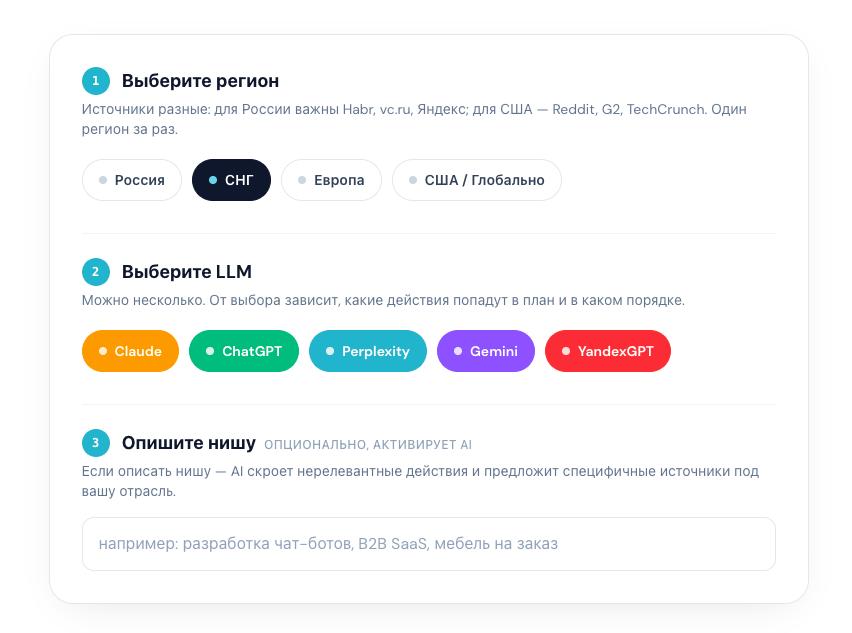
When CTR from Google started visibly dropping on queries with AI Overviews, one thing became clear: classic SEO doesn't cover the whole funnel anymore. A chunk of leads gets lost at a layer Google never even reaches — customers ask ChatGPT and get back a list of three companies. At AI MAP, we built a free tool that shows what to do and where to do it so you end up on that list. Here's how we built it and why this way.
The brief
AI MAP is a services team that builds chatbots and turnkey AI solutions for businesses. Our main lead channels are organic search and word of mouth. The brief was simple: we needed a lightweight content asset that would grab attention on a fresh topic (LLM visibility) and bring in leads who are interested in full turnkey implementation.
The idea itself — a series of mini-tools tied to current topics. In the industry this is usually called a lead magnet, but we prefer the term lead MVP: the user doesn't trade their email for a PDF, they immediately get a working product. That changes the intensity of the lead — instead of "I'll download it and read it later" you get "I tried it, I liked it, I need help with implementation".
How we picked the topic
The trend had to tick four boxes:
- actively discussed right now (rising searches and mentions);
- relevant to our services (so the leads are qualified);
- the reader has a concrete action they can take;
- almost no competition in Russian-language tooling.
LLM visibility hit all four. The topic took off in the English-speaking space in early 2026, reached Russian-language B2B later, and there were no tools targeting the CIS market.
Why we dropped the idea of a "real" API-based audit
The obvious first architecture: the user types in a brand, we hit every LLM's API, parse the answers, show "you're mentioned in 3 of 5". That's what Western SaaS products do, and it starts at $99/month.
We dropped that idea for three reasons.
Cost. An LLM API call costs money. Every run across five models and a few queries adds up to a few cents. For a free tool that has to survive a wave of LinkedIn traffic, that's bad economics.
Response time. API requests take seconds. If the user is staring at a spinner for 15–20 seconds, conversion craters.
Value of the answer. "You're mentioned in 3 of 5" is a diagnosis, not an action. The user gets a report and has no idea what to do with it. What we needed was for them to close the tool thinking "go there, do this".
So we went the other way: zero LLM calls on the main step, a static source map, zero sign-ups.
The source map — the main asset
The map is a table of actions. For every action it spells out which LLMs it affects, which regions it applies to, how much impact it has, how much effort it takes, how long it takes, exactly where to go, and why it works.
Let's get the main thing out of the way: the composition of training data at major LLMs is closed. OpenAI, Anthropic, Google and Yandex don't publish a detailed list of sources, weights and priorities. Which means any "map of where LLMs get their information" is a hypothesis, not a precise technical document.
Building the map, we leaned on what's publicly available:
Documentation on open corpora. Common Crawl, Wikipedia, open GitHub and Reddit datasets. These are known to be part of most major models' training corpora — it's mentioned in research papers from OpenAI (GPT-3), Anthropic (Constitutional AI), Google (PaLM, Gemini).
The architecture of fresh answers. Perplexity runs on top of the Bing index — they say so themselves. Google's AI Overviews and Gemini's search mode run on Google's index. ChatGPT's search mode — also Bing. These sources are easy to verify because the answers contain links.
Vendor statements. Yandex talks about training on "the Russian-language part of the internet", with no specifics. From that statement we hypothesized that services inside the Yandex ecosystem (Dzen, Q) get indexed more densely and end up in training more often than external resources — but there's no direct confirmation.
SEO community observations. Open studies and tests on which sites get cited in Perplexity, AI Overviews and Gemini. That's collective practitioner experience, not peer-reviewed research, but it does give a signal about which sources the models reference more often.
We baked a disclaimer into the tool that we think is critical: the plan shows priorities based on open data, but it does not guarantee you'll show up in LLM answers. That's more honest than selling a "guaranteed way to appear in ChatGPT in two weeks".
The tech stack
By our vibecoding standard this is a small project, so the stack is simple:
- Frontend and backend: Next.js (App Router) + Tailwind;
- Database: SQLite, only for event analytics;
- Hosting: inside the main domain at
aimap.agency/tools/llm-visibility/; - Development: Claude Code in VS Code, methodology
vibecoding-aimap.
Build took two days: one for the source map and the logic, the second for layout, review and integration with the aimap.agency design.
What we ended up with
The tool works in three steps. The user picks a region (Russia, CIS, Europe, USA), picks the LLMs they want to be visible in, types in their niche. They get back a list of actions sorted by strength — the most powerful and universal at the top, more niche ones below.
Each action opens up into a card: where to go, what exactly to do, why it works for the selected LLMs. No forms, no sign-ups, no emailed reports. Opened it — did it — closed it knowing what to do next.
Where AI does come in
The static map solves the "where everyone should go" problem. But a universal list has gaps: GitHub is great for tech, useless for dentistry; medical portals matter for a clinic but not for developers.
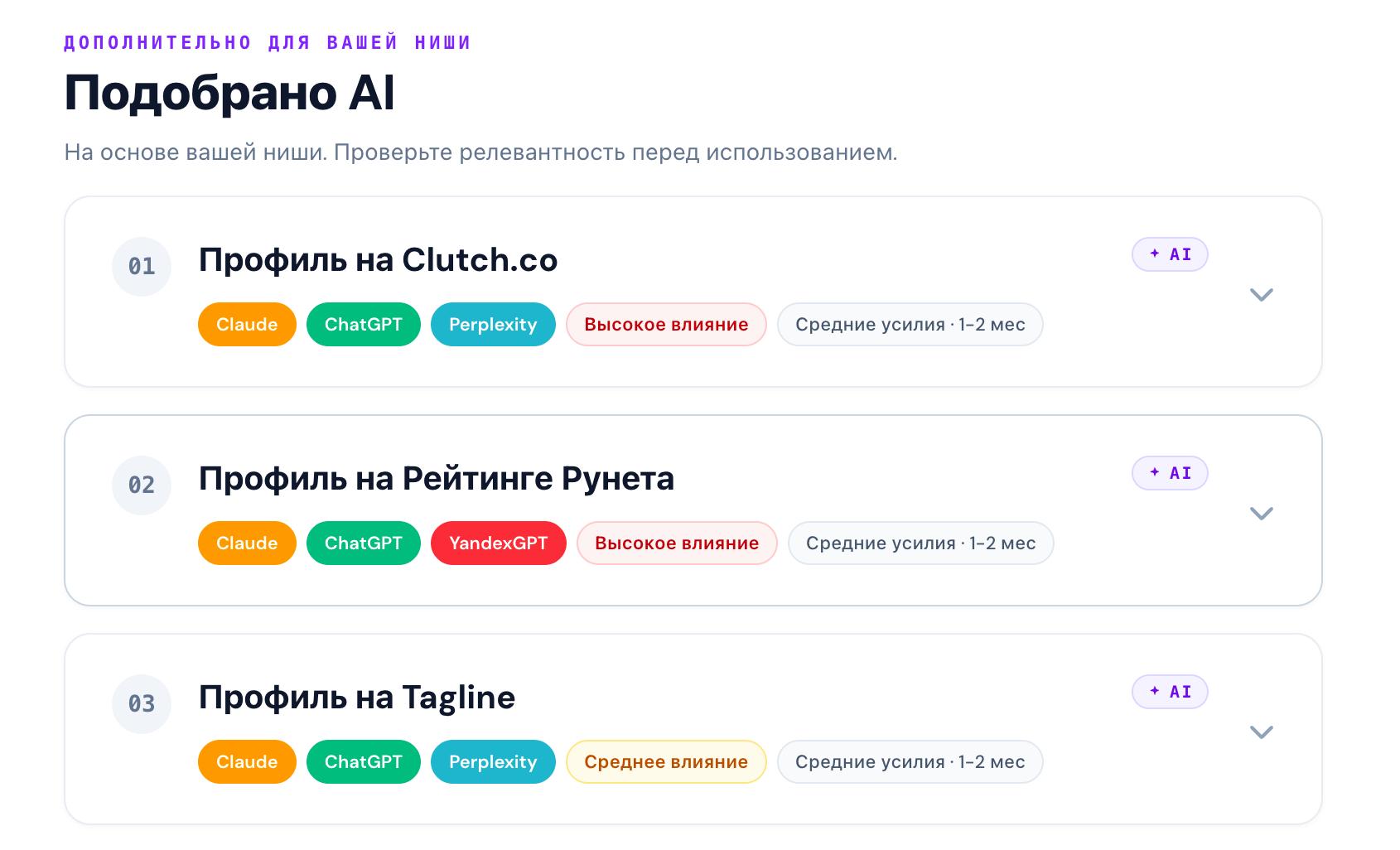
So after static filtering we make a single lightweight call to Claude Haiku. The model gets the chosen niche and the current list of actions, and returns two things: which items from the map should be hidden for this niche, and which 3–4 niche resources should be added on top (review sites, vertical directories, industry media).
The additions show up in a separate section labelled "Picked by AI" with a clear disclaimer — we don't pass off an LLM hypothesis as verified data.
The cost of this add-on is pennies. One Haiku call runs around three-thousandths of a dollar, and caching by a normalized "niche + region + LLM set" key cuts real API calls by 5–10x. Even during a viral spike of tens of thousands of checks, the API bill stays in the tens of dollars.
The CTA at the bottom of the page goes to AI MAP's Telegram — for people who'd rather just delegate the whole plan.
Where this approach works
Lead MVP (a working tool instead of a PDF checklist) isn't a one-off trick — it's a format we recommend wherever three conditions are true:
- The topic is hot, actively discussed right now, and there's no decent Russian-language tool for it.
- The product or service has a long sales cycle — you need a low-pressure first-touch mechanism.
- The audience is practical — they want to "try it", not "read about the features".
For setups like that, we build these as a bundle: article + working MVP.
The point — this is an MVP, not the final word
We want to be upfront. This tool solves a narrow problem: give a non-specialist an answer to "where to go and what to do" so their brand starts showing up in LLM answers. That's useful for a founder, a developer, or a small-business owner who doesn't have their own marketer.
But we're not marketers. And we're not SEO experts. We're engineers who spotted a trend, got into it deep enough to assemble a working map, and packaged it into a tool. The map is built on open data and logic, not on an empirical study of citation patterns in each LLM.
What that means:
— The tool answers "where do I start" with confidence. Wikipedia, vertical media, structured data on your site — that's a baseline that works for almost any niche.
— The tool doesn't answer the finer-grained questions: how often to publish, which specific formats convert better, how to measure LLM visibility over time, which strategies work in a specific B2B niche.
That's where we're open to collaboration. If you're a marketer, an SEO specialist, a GEO expert, or the founder of an LLM-visibility tracking platform, and you have methodology, data or hypotheses that would make this tool stronger — let's do this together. We're ready to invest engineering, access to our audience and the AI MAP platform. If the result lands, we can turn it into a joint study, an article, a product or a series.
What's next
This is the first tool in a series. For other current trends we're planning to ship: safety of AI agents in production, automation ROI assessment, diagnosing a company's readiness for AI adoption. Each one will be the same combo: article on AI MAP + working tool on aimap.agency.
If you have a topic where this kind of bundle could land in your niche, or you'd like to collaborate on one of the planned tools — get in touch.
Обсудите статью с AI
Нажмите кнопку — AI откроется с готовым запросом: пересказать статью и быть готовым ответить на ваши вопросы. Поддерживается Claude, ChatGPT и Gemini.
Откроется новая вкладка с предзаполненным запросом. Может потребоваться вход в аккаунт сервиса.
The tool, live: aimap.agency/tools/llm-visibility
AI MAP — AI solutions and business automation, Yerevan
Want a tool like this for your niche?
We build lead MVPs end-to-end — from picking the topic and assembling the data map to launch and analytics.
Discuss the project →A marketer, SEO or GEO expert?
If you'd like to strengthen our tool with your methodology or data — let's build it together. We're up for a joint piece.
Write to Leon →